
HFSA 2026 · Late breaker

Real-world data shows long-term improvements for heart failure patients.

Explore the findings
CCM

A recent research study* presented at the Heart Failure Society of America (HFSA) 2026 Annual Scientific Meeting showed CCM® Therapy patients experienced long-term improvements in heart failure hospitalization and other cardiac health indicators.

U.S. post-approval study

One-Year Real-World Clinical Outcomes Following Cardiac Contractility Modulation Therapy from the U.S. Post-Approval Study

Research data presented at the 2026 Heart Failure Society of America (HFSA) late breaker session.

Study overview

CCM® Therapy post-approval study and method

This was a prospective, multicenter, long-term observational study of CCM Therapy (NCT03970343).

Eligible patients: NYHA III, LVEF 25–45%, on maximally tolerated Guideline-Directed Medication Therapy (GDMT) and not receiving Cardiac Resynchronization Therapy (CRT).

Optimizer implant deviceCCM® Therapy
implant
1 yearFollow-up
2 yearsFollow-up
3 yearsFollow-up

The study paired baseline characteristics to one-year, snapshot assessments across the following four domains.

01

Clinical outcome

HF hospitalization

02

Functional status

NYHA

03

Symptoms and quality of life

Diuretic usage, MLHFQ1

04

Cardiac biomarker

NT-proBNP

At baseline

Patient accountability

530Patients
United States flag71U.S. sites
Feb 2020 – Jun 2026Study period

Baseline patient characteristics

CharacteristicsN=530
Age, years (mean ± SD)67.3 ± 10.9
Male (%)69.6
BMI (mean ± SD)31.7 ± 7.0
Non-ischemic (%)53.0
LVEF (%)37.7 ± 8.2
Atrial fibrillation (%)40.6
Diabetes (%)47.4
Concomitant CIED (%)74.5

Baseline GDMT and diuretics

>35% on SGLT2>56% on ARNI
MedicationN=530
Beta Blocker, %94.0
RAASI, %83.6
    ACE or ARB, %27.0
    ARNI, %56.6
Aldosterone Antagonist, %48.5
SGLT2 Inhibitor, %35.7

One-year outcomes

Clinical benefits observed across multiple cardiac health indicators

Clinical outcome

Heart failure hospitalization2

34%

Reduction in heart failure hospitalization at 1-year post-implant in patients already optimized on GDMT.

2. The effect of CCM® Therapy on hospitalization has not been evaluated by the US FDA and has not been studied in RCTs.

Events per patient-year

−34.0% · p=0.039
Time periodEventsPatient-yearsEvent rate
Pre-CCM, 1 year (n=338)152338.00.45
Post-CCM, 1 year (n=338)91306.80.30
Functional status

Improved or stabilized NYHA

97%

Patients had improved/stabilized NYHA functional class at 1-year.

68.1%improved by ≥1 class

NYHA change from baseline

N=520
NYHA change from baselineN (%)
Improved by 2 classes117 (22.5)
Improved by ≥1 class354 (68.1)
Stabilized150 (28.8)
Worsened16 (3.1)
Symptoms

Diuretic utilization

35%

Patients receiving diuretics at baseline discontinued/decreased diuretic therapy.

In patients receiving diuretics at baseline,
18% discontinued diuretic therapy completely.

Diuretic usage at 1-year

In patients using diuretics at baseline

  • Stable
  • Decrease
  • Discontinue
  • Increase


Cardiac biomarker

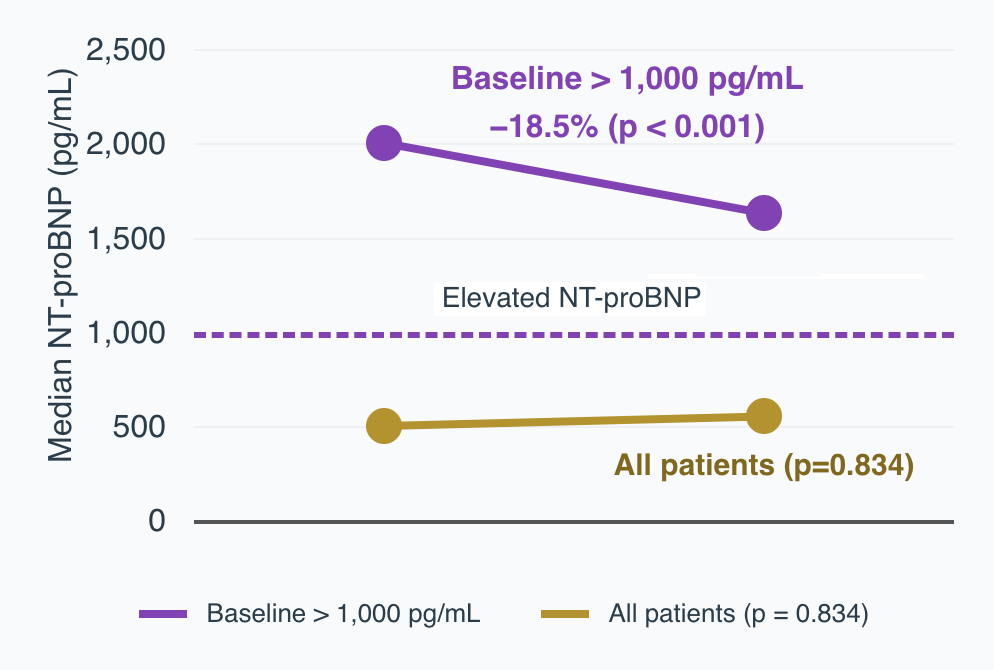
NT-proBNP

18.5%

Decrease in NT-proBNP in patients with elevated baseline, a key biomarker of HF.

Median NT-proBNP (pg/mL)

Elevated baseline · p<0.001
Line Chart
Quality of life

Meaningful improvement in MLHFQ1

70%

Patients who achieved the minimal clinically meaningful improvement of ≥5 pts as per the MLHFQ.

Quality of life as assessed by MLHFQ improved by an average of 16.7 pts (p<0.001).

Patients with improved MLHFQ scores

Baseline MLHFQ53.7
1-year MLHFQ36.8

1. MLHFQ = Minnesota Living with Heart-Failure Questionnaire.

Explore the research

Gain more insight into the findings of the study.

Download the full graphic abstract

Contact us

Discuss the research findings.

If you would like to discuss the research findings with an Impulse Dynamics Medical Affairs associate, please fill out the form below.

Name(Required)